
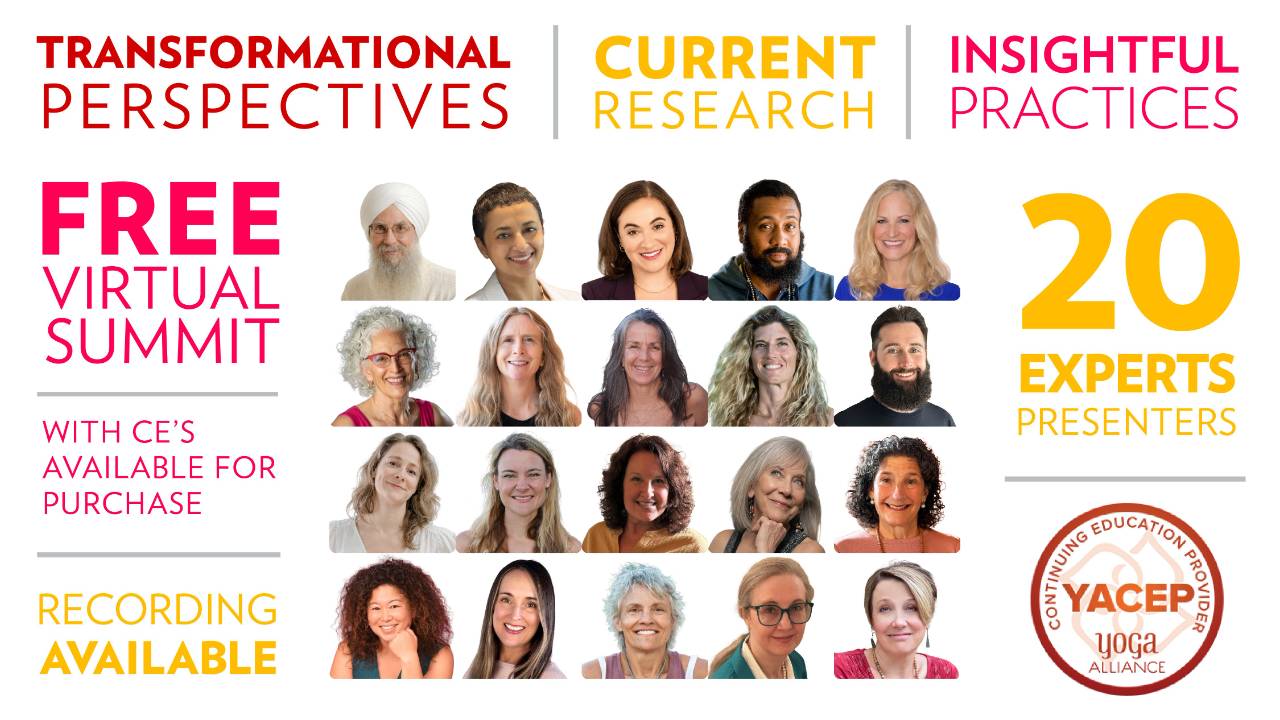
Sign me up for this free vitual event!
Yes, please! Send me links to the live Zoom events and recordings of the calls.
Join Us for the 4th Annual How Yoga Heals Telesummit
Explore Transformational Perspectives for Body, Mind, Heart and Brain Well-Being
November 6-9, 2026
OPEN TO ALL — ATTEND FREE
Join an inspiring lineup of C-IAYT Yoga Therapists, clinicians, educators, and wellness professionals for four days of live online sessions exploring yoga, somatics, nervous-system regulation, pain, mental health, breath, movement, and whole-person healing.
Your free registration includes live Zoom access + 48-hour replay access to every session.
Yoga Teachers: Lifetime access + Yoga Alliance Continuing Education credits available for $47 through November 7.
Live Zoom or Get the Recordings
Review the Lineup- November 6-9, 2026
The Anatomy of Yoga: Science, Synergy and Practice
With Tess O'Hern, C-IAYT
November 6 at 8:00–9:00 AM PST (California)/11:00 AM–12:00 PM (New York)/4:00–5:00 PM (London)
This presentation explores how yogic practices impact and support the interconnected systems of the human body. Together, we’ll uncover the science behind how yoga supports the entire body.
This interactive session examines the complex, symbiotic relationships between body systems and demonstrates how targeted practices—including asana, pranayama, and meditation—can optimize overall physiological function.
We will demystify common anatomical misconceptions in popular yoga instruction, grounding our exploration in current evidence-informed research. By taking an anatomical lens, participants will deepen their understanding of body mechanics and gain actionable insights to enhance posture, breathing, and daily vitality.
Tess O’Hern holds a doctorate in Physical Therapy and worked as a physical therapist, Therapy Manager, and Chief Therapist for California Children’s Services in Los Angeles and Orange Counties for 23 years. She received her Clinical Yoga Therapist Certification from Loyola Marymount University in 2012 and her C-IAYT credential in 2017. Tess is co-founder and co-director of the AlcheMe Yoga Therapy Program in Irvine, California, and currently serves as a volunteer on the International Association of Yoga Therapists Accreditation Committee.
The Science and Research on Yoga for Sleep and Insomnia
With Sat Bir Singh Khalsa, PHD
November 6 at 9:15–10:45 AM PST (California) / 12:15–1:45 PM (New York)/ 5:15–6:45 PM (London)
There is an increasing recognition and knowledge about the value of sleep in both physiology, psychology and human performance. There is emerging evidence of the negative impact of restricting one’s duration of night-time sleep, which is an increasing trend in modern society. Furthermore, there is also an increasing burden and prevalence of sleep disturbances and disorders, especially chronic insomnia, which is believed to be strongly influenced by stress and arousal.
Behavioral treatments for insomnia have been well-validated and there is strong research evidence demonstrating the high effectiveness of yoga for alleviating stress and arousal. However, these approaches, which are free of the side effects and other complications with sleeping pills, are not well known and poorly implemented. This lecture will describe the characteristics and importance of sleep to mental and physical health and performance and the underlying characteristics of insomnia, and will overview the well-known behavioral treatments for insomnia and the research demonstrating the efficacy of yoga for sleep quality and insomnia.
Sat Bir Singh Khalsa, Ph.D., is a Corresponding Member of the Faculty of Medicine at Harvard Medical School, retiring as Associate Professor of Medicine, and is Director of Research for the Kundalini Research Institute. He has conducted scientific research on the efficacy of yoga for mental health since 2001. He chairs the scientific program committee for the International Association of Yoga Therapists’ annual conference, serves as editor-in-chief of the International Journal of Yoga Therapy, and is chief editor of the medical textbook The Principles and Practice of Yoga in Health Care.
Your Practice Is Your Mirror: How Your Nervous System, Design, and Self-Trust Shape the Way You Serve
With Joy Miyatake, C-IAYT
November 6 at 11:00 AM–12:00 PM PST (California)/2:00–3:00 PM (New York)/ 7:00–8:00 PM (London)
This experiential session explores how nervous-system patterns can influence self-trust, boundaries, relationships, visibility, and the ways we show up in service to others.
Joy will examine patterns such as overgiving, people-pleasing, burnout, and mistrusting one’s own inner knowing through the lenses of yoga therapy, somatic awareness, and Human Design-informed self-inquiry.
Joy Miyatake is a Certified Yoga Therapist, Human Design Strategist, and founder of Joyful Presence®. Her work combines body-based trauma support, nervous-system regulation, somatic wisdom, and Human Design-informed strategy to help practitioners and leaders cultivate greater self-trust and grounded presence.
Leadership and Resilience from Embodied Practice: Individual Healing for Collective Liberation
With Reggie Hubbard, E-RYT 500
November 6 at 12:45–2:15 PM PST (California)/3:45–5:15 PM (New York)/8:45–10:15 PM (London)
The complexity and uncertainty of the times we are living in require a depth and diversity of practice to help us metabolize grief, adversity, and change—both individually and collectively.
Drawing from his lived experience as an activist, yoga and meditation practitioner, stroke survivor, and sonic practitioner, Reggie will guide participants into deeper inquiry around nourishment, fearless authenticity, service, and the relationship between individual healing and collective liberation.
Reggie Hubbard is the founder and Chief Serving Officer of Active Peace. His work brings together community, well-being, meditation, movement, sound, and engaged citizenship. He holds the E-RYT 500 and YACEP credentials through Yoga Alliance and has completed more than 1,000 hours of study with teachers including Sri Dharma Mittra, Rod Stryker, Amy Ippoliti, and Faith Hunter. He is also a graduate of the Mindfulness Meditation Teacher Certification Program led by Jack Kornfield and Tara Brach.
The Neuro-Yoga Psychology Model: The Science Behind How Yoga Heals
With M. Mala Cunningham, Ph.D., C-IAYT
November 6 at 2:30–4:00 PM PST (California)/5:30–7:00 PM (New York)/10:30 PM–12:00 AM (London)
Dr. Mala Cunningham introduces her Neuro-Yoga Psychology Model, mapping the Eight Limbs of Yoga to psychological and neurological processes.
Participants will explore the vagus nerve, nervous-system regulation, neuroplasticity, and ways Neuro-Yoga Hatha can be sequenced to support physical, mental, and emotional health.
Mala Cunningham, Ph.D., is a licensed psychotherapist, author, educator, yoga therapist, and international speaker specializing in Integrative Medicine and Neuro-Yoga Psychology™. She previously served on the University of Virginia nursing and medical school faculty and founded certification programs in Cardiac Medical Yoga, Neuroscience and Yoga, and The Neuroscience of Mental Health.
Beyond the Mat: The Yoga Sutras as a Therapeutic Framework
With Cathryn Wilson, M.A., APCC, C-IAYT, E-RYT 500
November 7 at 8:00–9:00 AM PST (California)/11:00 AM–12:00 PM (New York)/4:00–5:00 PM (London)
The Yoga Sutras are often introduced as a philosophical text or guide to meditation, yet they also offer a remarkably sophisticated framework for understanding the human experience of suffering.
In this session, Cathryn Wilson explores the Yoga Sutras through a therapeutic lens, examining how Patanjali’s teachings can help us understand patterns that contribute to psychological distress—and the practices that cultivate greater freedom, discernment, and resilience.
Participants will explore the kleshas as patterns shaping perception and behavior, abhyasa and vairagya as practices for working with habitual responses, and the Eight Limbs of Yoga as a multidimensional model for psychological and embodied well-being.
Rather than treating the Sutras as abstract philosophy, we will consider how these teachings can become practical tools for working with anxiety, reactivity, self-criticism, attachment, avoidance, and persistent mental patterns.
The session weaves together yogic philosophy, contemporary psychology, reflection, and embodied practice, offering an accessible way to begin applying the Sutras within our own lives and teaching.
Cathryn Wilson is a therapist, yoga therapist, trained Dance/Movement Therapist, and Director of Soma Yoga Institute. Her work explores the intersection of yoga philosophy, psychology, nervous-system regulation, and embodied approaches to healing. Cathryn holds a master’s degree in counseling and has studied Indian philosophy at the University of Hyderabad in India.
Yoga for People in Addiction Recovery
With Robert Guilmette, C-IAYT, E-RYT 500
November 7 at 9:15–10:45 AM PST (California) / 12:15–1:45 PM (New York)/ 5:15–6:45 PM (London)
Explore yoga as a supportive practice for people experiencing substance use disorder, particularly during early recovery.
Rob will address self-regulation, psychological flexibility, self-compassion, agency, and ways yoga teaching may need to be adapted for addiction-treatment environments through simplicity, choice, repetition, safety, and nervous-system regulation.
Rob Guilmette is a Certified Yoga Therapist and E-RYT 500 who has taught professionally since 2013. He currently teaches yoga in a residential addiction-treatment setting, where he developed a curriculum specifically for people in recovery. His approach is informed by both his professional work and personal experience with substance use and recovery.
Tapping Into Chair Yoga and Your Nervous System for Living with Pain
With Susanne Murtha, C-IAYT, E-RYT 500, CPMC, NBC-HWC
November 7 at 11:00 AM–12:00 PM PST (California) / 2:00–3:00 PM (New York)/ 7:00–8:00 PM (London)
When we experience pain, there is a natural urge to do something about it—to identify the cause and seek help. Yet we can sometimes overlook the resources already available within our own bodies.
In this session, Susanne explores seven mind-body-yoga strategies grounded in research and yogic wisdom and adapts them to chair yoga.
Participants will explore tools including Sankalpa, breathing, gentle movement, self-touch, Progressive Muscle Relaxation, Yogic Somatic Tracking, Gate Control Theory, and the intentional use of exteroception and interoception.
Susanne Murtha brings 30 years of teaching experience to making yoga genuinely accessible for people managing pain. A Certified Yoga Therapist and Pain Management Coach, she has worked with hundreds of individuals living with pain and has spent 18 years bringing yoga to rural and underserved communities in the Adirondacks.
Experiential Anatomy as Therapy
With Leila Stuart, BA, LLB, RMT (retired), C-IAYT
November 7 at 12:45–2:15 PM PST (California) / 3:45–5:15 PM (New York)/ 8:45–10:15 PM (London)
Leila explores interoception as a pathway to healing and demonstrates how experiential anatomy, somatic inquiry, and yoga therapy can help us recognize and repattern habitual ways of breathing, moving, and responding.
Participants will develop embodied experiences of qualities such as grounding, stability, and centering that can extend well beyond the yoga mat.
Leila Stuart is a pioneer in embodied movement education with more than 35 years of experience teaching embodied movement and anatomy as yoga therapy. A retired clinical massage therapist and C-IAYT Yoga Therapist, she opened one of Canada’s first dedicated yoga therapy studios and taught a 300-hour yoga therapy training for 14 years. She is the author of Experiential Anatomy: Therapeutic Applications of Embodied Movement and Awareness and co-author with Donna Farhi of Pathways to a Centered Body.
Perimenopause & Beyond: Strengthening Through the Transition
With Jess Trudeau, E-RYT 500
November 7 at 2:30–4:00 PM PST (California) / 5:30–7:00 PM (New York)/ 10:30 PM–12:00 AM (London)
What happens to our bodies during perimenopause—and how can yoga help us meet these changes with strength and intention?
This introductory lecture and Yoga with Weights practice explores changes in muscle, bone, metabolism, and recovery during the menopause transition, along with current research surrounding resistance training for women in midlife and beyond.
Participants will explore how incorporating weights into yoga can support strength, bone health, balance, stability, and functional movement while maintaining the mindfulness, mobility, breath, and embodiment that make yoga unique.
Jess Trudeau, E-RYT 500, began practicing yoga in 1999. Her practice became an important foundation throughout motherhood and a serious illness with Guillain-Barré syndrome that temporarily left her paralyzed in 2016. Her teaching reflects a deep appreciation for the body’s capacity for resilience and transformation.
Meditation for Positive Mindset: Transform Healing to Thriving
With Megan McCarver, M.A., C-IAYT, E-RYT 500
November 8 at 8:00–9:00 AM PST (California) / 11:00 AM–12:00 PM (New York)/ 4:00–5:00 PM (London)
Join this welcoming one-hour online meditation experience designed to help transform a healing state of body-mind into a thriving state of being.
Through guided meditation, participants will learn three gentle practices designed to reduce stress, improve focus, and cultivate a more loving inner dialogue.
You’ll also explore personalized affirmations and practical techniques for shifting unhelpful thought patterns, strengthening resilience, and nurturing confidence, gratitude, and hope.
Megan McCarver, M.A., C-IAYT, E-RYT 500, is a yoga teacher and yoga therapist whose practice is rooted in the Krishnamacharya lineage and influenced by Buddhist traditions, Ayurveda, and Yoga lifestyle teachings. She offers private yoga therapy, medical-clinic groups, online meditation, retreats, mentorship, and professional education.
Burnout to Breathing: Reclaiming the Intelligence of the Body and Breath
With Dr. Ela Manga, MBBCh, DCH, DipObst, CBP
November 8 at 9:15–10:45 AM PST (California) / 12:15–1:45 PM (New York)/ 5:15–6:45 PM (London)
Burnout is often understood as the result of too much demand and too little recovery. In this session, Dr. Ela Manga explores burnout through a multidirectional lens—physiological, psychological, relational, and spiritual.
What changes when we understand the body as an intelligent system designed to support the flow of life?
From this perspective, breathing becomes a way of listening to and working with the intelligence of the body to support energy, regulation, resilience, and our capacity to engage with life.
Participants will experience these ideas within their own bodies and leave with a simple, accessible toolkit of breath and body practices for regulation, restoration, energy, and presence.
Dr. Ela Manga is an integrative medical doctor, author, speaker, and breathwork practitioner. She is founder and CEO of Breathwork Africa and author of BREATHE: Strategising Energy in the Age of Burnout and UMOYA: The Science and Wonder of Conscious Breathing. Her work brings together modern medicine, neuroscience, embodied practice, and ancient wisdom.
Yoga Skills for Children’s Emotional Regulation
With Christine McArdle, MA, Author, E-RYT 500
November 8 at 11:00 AM–12:00 PM PST (California) / 2:00–3:00 PM (New York)/ 7:00–8:00 PM (London)
This experiential workshop explores practical, age-appropriate yoga tools that can support children in recognizing, expressing, and regulating emotions.
Participants will learn how simple movement, breathing practices, mindfulness, sensory awareness, and grounding techniques can help children develop greater body awareness, emotional resilience, and a sense of safety and calm.
The workshop includes an accessible introduction to the nervous system and emotional regulation alongside concrete practices that can be adapted for classrooms, therapeutic settings, yoga classes, and home.
Christine McArdle began practicing yoga while working as a first-year elementary school teacher in 1990. She quickly recognized the emotional balance, clarity, and strength yoga offered in navigating a demanding teaching career. Since then, the study and practice of yoga combined with the art and science of teaching have become her life’s work.
Somatic Movement for Frozen Shoulder: A Nervous System & Fascia-Informed Approach
With Liz Heffernan, M.A., C-IAYT, E-RYT 500
November 8 at 12:45–2:15 PM PST (California) / 3:45–5:15 PM (New York)/ 8:45–10:15 PM (London)
Explore a gentle, pain-free approach to frozen shoulder through Somatic Movement, nervous-system regulation, and emerging fascia research.
Through discussion and mindful movement, you’ll discover techniques to reduce protective muscular holding, improve sensory awareness and motor control, and restore comfortable movement without forcing range of motion.
We’ll explore how movement needs may change through the freezing, frozen, and thawing stages while integrating Somatic Movement, gentle myofascial release, and supported restorative practices.
Participants will gain practical tools for supporting shoulder mobility, reducing chronic tension, and building greater confidence and ease in movement.
Please bring: a tennis ball or yoga therapy ball and two yoga blankets.
Liz Heffernan, M.A., E-RYT 500, C-IAYT, is an international yoga teacher and Certified Yoga Therapist with more than 30 years of teaching experience. A founding faculty member of Soma Yoga Institute, Liz specializes in Somatic Movement, Yoga Nidra, therapeutic Hatha Yoga, healthy aging, and nervous-system regulation.
Meeting the Person, Not the Diagnosis: Lessons from Therapeutic Yoga in Cardiac & Cancer Care
With Becky Michalski, RN, BSN, C-IAYT
November 8 at 2:30–4:00 PM PST (California) / 5:30–7:00 PM (New York)/ 10:30 PM–12:00 AM (London)
Drawing from cardiac rehabilitation and cancer recovery, Becky explores how therapeutic yoga can address the whole person rather than simply treating a diagnosis.
She will discuss adapting movement, breath, rest, pacing, and language according to individual needs while emphasizing choice, agency, appropriate challenge, and rebuilding trust in the body.
Becky Michalski, RN, BSN, C-IAYT, is a registered nurse, Certified Yoga Therapist, and founder of Rooted Radiance Yoga Therapy. With more than 20 years of nursing experience, she integrates clinical knowledge with therapeutic yoga and has worked within cardiac rehabilitation and cancer recovery programs.
Intimate Inquiry: Whole Person Pelvic Care, Sexuality, and Women’s Fulfillment
With Cheri Ryba, C-IAYT, FME 3, Author
November9 at 8:00–9:00 AM PST (California) / 11:00 AM–12:00 PM (New York)/ 4:00–5:00 PM (London)
This experiential session examines pelvic health, sexuality, intimacy, and embodiment through yoga and somatic inquiry.
Cheri will explore how practitioners can support whole-person pelvic care while addressing shame, disconnection, trauma, agency, pleasure, and post-traumatic growth.
The session incorporates experiential practices, case studies, yoga philosophy, and important considerations surrounding professional scope and referral.
Cheri D. Ryba, C-IAYT, FME 3, is an author and yoga therapist with more than 20 years of experience in movement, self-inquiry, embodiment, yoga, and women’s intimate health. She is the author of Pelvic Yoga Therapy for the Whole Woman: A Professional Guide and has additional training as a Somatic Sexuality Healing Practitioner.
The Body Knows: Movement, Trauma & the Intelligence of Healing
With Erica Hornthal, MA, LCPC, BC-DMT
November 9 at 9:15–10:45 AM PST (California) / 12:15–1:45 PM (New York)/ 5:15–6:45 PM (London)
What if healing doesn’t begin with changing your thoughts—but with changing how you move?
In this experiential 90-minute session, Erica Hornthal, “The Therapist Who Moves You,” explores how movement can become a pathway to emotional regulation, trauma recovery, and deeper self-awareness.
Drawing from dance/movement therapy, neuroscience, somatic psychology, and Kinesthetic Cognitive Therapy, participants will discover how the body communicates what the mind may not yet have words for.
Through accessible movement explorations, reflection, and practical therapeutic tools, participants will experience how qualities of movement can influence the way we think, feel, relate, and heal.
Erica Hornthal, MA, LCPC, BC-DMT, is a licensed clinical professional counselor, board-certified dance/movement therapist, and founder of Chicago Dance Therapy. She earned her MA in Dance/Movement Therapy and Counseling from Columbia College Chicago and is creator of Kinesthetic Cognitive Therapy. Erica is the author of Body Aware, Body Talk, and The Movement Therapy Deck.
Understanding Low Back Pain: A Functional, Therapeutic Yoga Approach
With Robin Rothenberf, C-IAYT
November 9 at 11:00 AM–12:00 PM PST (California) / 2:00–3:00 PM (New York)/ 7:00–8:00 PM (London)
Low back pain is one of the most common—and often misunderstood—conditions yoga teachers and movement professionals encounter.
In this practical and clinically informed session, Robin Rothenberg explores why backs hurt and how yoga professionals can move beyond generic “low back” practices toward a more individualized understanding of function.
Participants will explore the relationship between breathing, pelvic organization, stability and mobility, and common patterns of low back and sacroiliac discomfort.
Robin will highlight the importance of distinguishing between bodies that need greater mobility and those that need greater stability, helping teachers avoid the common mistake of stretching areas that may actually require support.
Through accessible education and experiential practice, participants will gain practical movement and cueing strategies they can begin applying in yoga classes, private sessions, and their own practice, along with a clearer understanding of when symptoms warrant referral to a healthcare provider.
Robin Rothenberg, C-IAYT, is an internationally respected yoga therapist specializing in supporting people with respiratory, immune, and structural imbalances through yoga and therapeutic breathing practices. She is the author of Restoring Prana: A Guide to Pranayama and Healing Through the Breath and its companion, The Svadhyaya Breath Journal. Robin currently serves as interim board president of the International Association of Yoga Therapists.
The Five Prana Vayus: Breathing, Energy & the Intelligence of the Body
With Peggy Profant, C-IAYT, E-RYT 500
November 9 at 12:45–2:15 PM PST (California) / 3:45–5:15 PM (New York)/ 8:45–10:15 PM (London)
The yogic tradition describes five primary movements of prana—the Prana Vayus—that organize the flow of energy throughout the body and influence breathing, digestion, elimination, circulation, expression, and integration.
In this experiential session, Peggy Profant explores the Vayus as a practical framework for understanding the relationship between breath, physiology, and embodied well-being.
Participants will explore Prana, Apana, Samana, Udana, and Vyana Vayu, learning how each directional movement can be experienced through breathing, posture, awareness, and gentle yoga practice.
Rather than approaching the Vayus only as an esoteric concept, Peggy will illuminate how this traditional model can help us observe patterns of effort, holding, depletion, grounding, expansion, and regulation within ourselves and our students.
Through discussion and guided practices, participants will experience ways of working with the five Vayus to support greater balance, vitality, ease, and self-awareness.
Peggy Profant, C-IAYT, E-RYT 500, is a Certified Yoga Therapist with the International Association of Yoga Therapists, a Certified Anusara Yoga Teacher, and a lead teacher trainer for Soma Yoga Institute since 2016. Her approach blends the ancient wisdom of yoga with biomechanically sound alignment to help students become more firmly anchored in their true, radiant self.
Beyond Kegels: A Nervous System–First Approach to Pelvic Health
With Alicia Cuglietta, E-RYT 500, C-IAYT, TIYT
November 9 at 2:30–4:00 PM PST (California) / 5:30–7:00 PM (New York)/ 10:30 PM–12:00 AM (London)
Many people experiencing pelvic pain, persistent tension, or incontinence have tried strengthening, stretching, or isolated pelvic-floor exercises without lasting success.
This experiential session explores the often-overlooked relationship between the nervous system and pelvic-floor function, including the roles of stress physiology, protective muscle tension, persistent pain, and breathing patterns.
Grounded in pain science, trauma-informed care, and yoga therapy, Alicia combines education with experiential practices incorporating breath, movement, and guided relaxation.
Participants will leave with a whole-person framework and practical strategies for supporting pelvic pain, overactive pelvic-floor dysfunction, incontinence, and related conditions.
Alicia Cuglietta, C-IAYT, E-RYT 500, TIYT, is a yoga therapist specializing in pelvic health, women’s health, chronic pain, anxiety, and nervous-system regulation. For more than a decade, she has used trauma-informed yoga therapy to support people experiencing anxiety and persistent pain. Alicia is also creator and instructor of an IAYT-approved continuing education course in Yoga Nidra/NSDR for yoga professionals.